
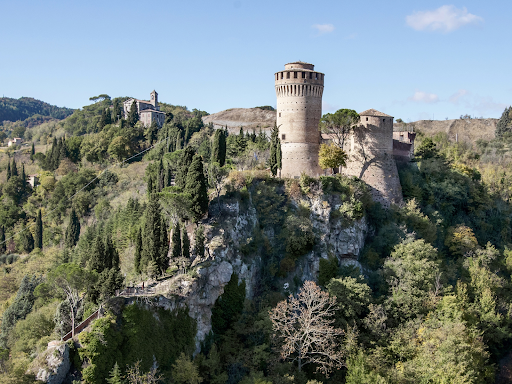
Italy’s lesser-known places often hold the richest surprises. In Emilia-Romagna, Brisighella greets visitors with cliffs and towers that seem sketched by a Renaissance artist. Trees cling to the rocks in unlikely places, and isolated fortifications hint at centuries of stories.
The town itself is intimate and walkable. Narrow stone alleys lead to an unusual raised path that threads through the buildings, creating secret vantage points over rooftops and hills. It makes a peaceful base to explore the countryside, with its mixture of farmland and wild escarpments.
Far away, in Sicily’s Madonie mountains, the Via dei Frati trail connects Caltanissetta and Cefalù on a 54-mile route almost untouched by mass tourism. Days pass without encountering another hiker, and evenings end in villages such as Gangi, where communication relies more on warmth than shared vocabulary.
In Basilicata, Venosa proves that even small towns can hold vast history. Roman remains, Jewish catacombs and a powerful castle testify to its former importance. Nearby castles at Melfi and Lagopesole and the noble palace at Pietragalla form a chain of sites that would draw crowds in more visited regions but remain largely undisturbed.
Add to that a secluded eco-hotel in the Apennines where the stars stand out in the dark sky, Cividale’s medieval heart and turquoise river, Chioggia’s canals and Adriatic beaches, the rugged mountains of Santo Stefano d’Aveto, the vineyard-covered slopes around Loazzolo and the Roman ruins of Urbs Salvia near Urbisaglia. Together they offer a different map of Italy: quieter, more personal and wonderfully unspoiled.