
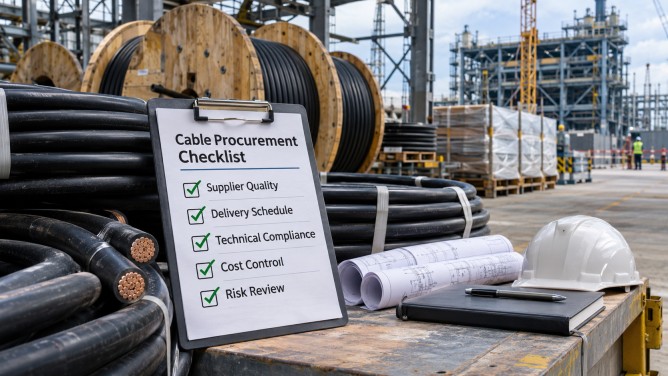
XWA Power & Cable has unveiled a comprehensive guide aimed at reducing procurement risks in international engineering, procurement, and construction (EPC) projects. The guide identifies five critical areas where early checks in cable specifications can prevent supply discrepancies, failed acceptance tests, and commissioning delays. Drawing from 17 years of overseas cable supply experience, the guidance is tailored for EPC engineering and procurement teams involved in medium- and high-voltage cable projects, as well as contractors handling low-voltage and control cable packages.
The guidance highlights the importance of complete cable descriptions, which often omit essential details such as semiconductive screens, metallic screening, and water-blocking arrangements. For example, the designation “AL/XLPE/AWA/PVC 3 × 185 mm² 11kV” may not cover all necessary manufacturing details. XWA stresses the need for a written, layer-by-layer review of components from conductors to moisture protection before finalizing manufacturing instructions.
Material choices significantly impact electrical and mechanical performance. The guide compares copper tape screen (CTS) and copper wire screen (CWS), noting a potential cost difference of over 10% and a variance in short-circuit performance by 30%–50%. Such differences must be assessed based on fault magnitude and duration. Similarly, the choice of armour, such as magnetic steel armour on single-core AC cables, can affect current-carrying capacity, potentially reducing it by 15%–25% if improperly selected.
Environmental factors are also crucial, as highlighted by CIGRE findings which attribute more than 60% of insulation failures in cables rated 110kV and above to water-treeing. XWA advises confirming water-blocking requirements and site conditions like coastal corrosion or tropical humidity. Clarifying local product descriptions and material specifications is also recommended to avoid misunderstandings, such as mistaking copper-clad steel (CCS) for pure copper.
Testing and documentation must align with actual cable design and project needs, involving tests like AC withstand and partial-discharge measurements. XWA coordinates with qualified partners to ensure testing begins within 48 hours post-production, adhering to standards like IEC 60502-2 and IEC 60840.
Finally, the guide addresses transport and installation concerns, warning of potential failures that could arise if these are not adequately reviewed. XWA cites a Mongolian project where improper armour choice led to significant issues within three months of operation. The company advocates for thorough installation reviews, covering aspects like bending radius and sheath protection, to prevent costly errors and delays.
Overall, XWA’s guidance aims to assist international EPC purchasers and project teams in making informed decisions, reducing the risk of costly rejections and ensuring consistency in project execution. The company emphasizes resolving technical ambiguities upstream to facilitate effective comparison and coordination among project stakeholders.
joaquin Fan
XWA Power & Cable
+86 153 2498 1792
[email protected]
Legal Disclaimer:
The information contained in this article has been provided by independent third-party contributors, clients, or content partners. We do not independently verify the accuracy, completeness, legality, ownership, licensing, or reliability of submitted content, including text, images, videos, trademarks, or other media materials. The submitting party is solely responsible for ensuring that all content, including images and media assets, complies with applicable copyright, trademark, licensing, and intellectual property laws. We disclaim liability for any unauthorized use of copyrighted or proprietary materials by third parties. If you believe that any content published on this platform infringes your intellectual property rights, kindly contact the author above for prompt review and resolution.